
Data-driven car maintenance: how to stop guessing and start preventing breakdowns
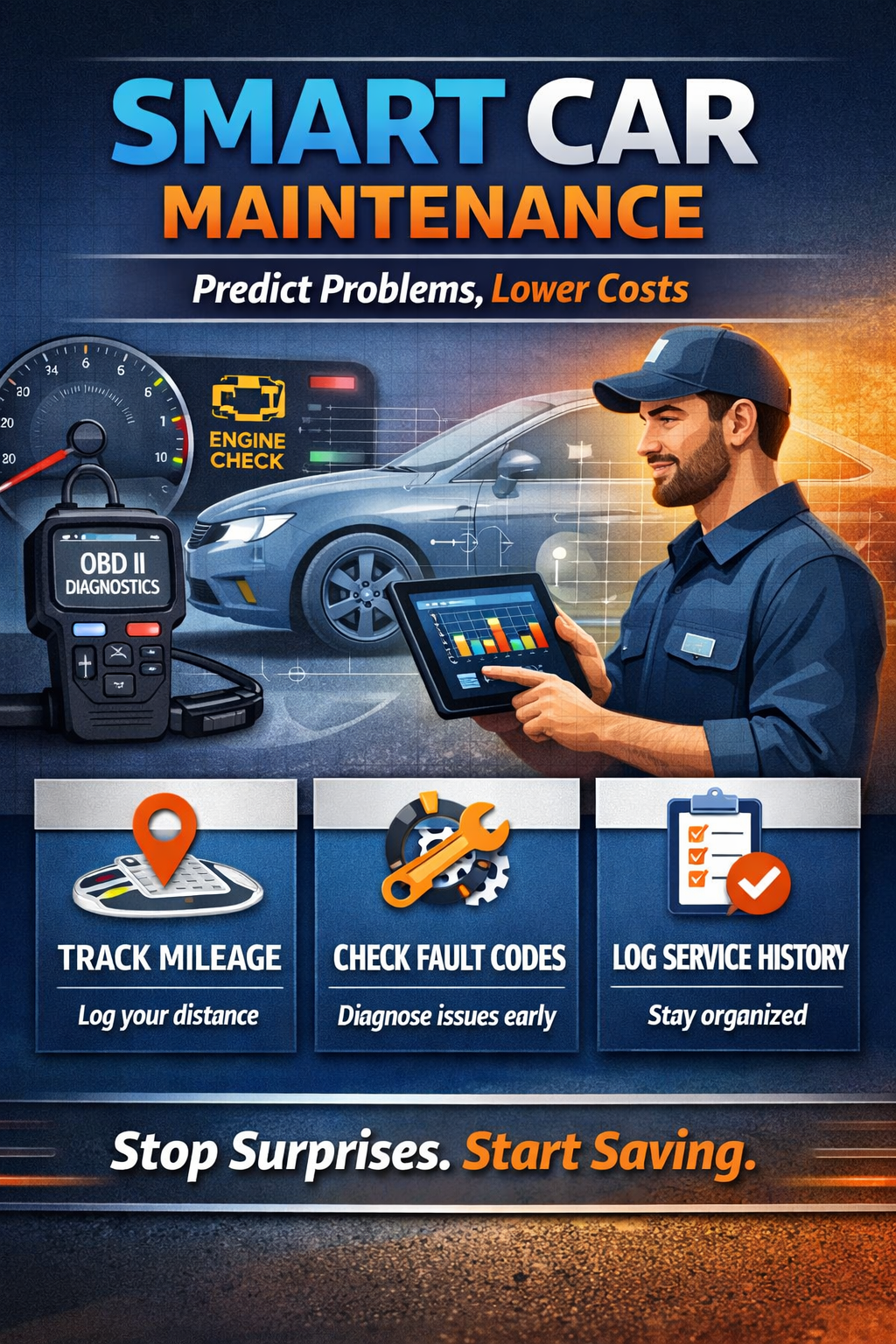
Car ownership feels a lot better when your next repair isn’t a surprise. Data-driven car maintenance is how you get there: you stop relying on vague “it’s probably fine” instincts and start using real signals—mileage, diagnostics, sensor readings, and service history—to stay ahead of wear.
If you want a simple, modern way to centralize records and reduce guesswork, start here: OlyCars: Smart Car Care, Real Data, Zero Guesswork.
TL;DR
- Use vehicle data (OBD, mileage, service history) to predict needs, not guess them.
- Follow simple schedules (30/60/90) and condition checks to prevent common failures.
- Choose tools that automate alerts and keep a single, searchable maintenance record.
Key takeaways
- Data-driven maintenance replaces guesswork with measurable signals: mileage, fault codes, and condition checks.
- Predictive and condition-based checks extend component life and reduce surprise repairs.
- Start small: track mileage, log services, set alerts, and refine thresholds from real data.
- Useful data sources include OBD-II/telematics, maintenance history, driving patterns, and sensor readings.
- The simplest plan is a 5-step setup: capture data, set rules, run checks, schedule service, review outcomes.
What is data-driven car maintenance?
Definition and core principles
Data-driven car maintenance means scheduling and performing upkeep based on measurable signals—mileage, diagnostic trouble codes (DTCs), sensor readings, and past service history—instead of relying only on calendar time or intuition.
The mindset is simple:
- Capture vehicle data
- Compare it to thresholds or trends
- Act before failure
Instead of waiting for a breakdown (or hoping your car “sounds fine”), you use a few dependable inputs to make calmer, smarter decisions.
Predictive vs preventive vs condition-based maintenance
These terms get mixed together, but they’re different tools—and the best real-world approach usually blends them:
- Preventive (time- or mileage-based): Replace or service items at set intervals (for example, oil every X miles) regardless of condition.
- Condition-based: Inspect or replace when a measured parameter (fluid level, brake pad thickness) crosses a threshold.
- Predictive: Use trends and diagnostics (fault codes, vibration/temperature trends) to forecast when a part will fail and replace it just in time.
Most drivers get the biggest benefit from combining all three: preventive schedules for routine items, condition checks for wear items, and predictive signals for the systems that fail in more complicated ways.
Why use data to prevent breakdowns
Top benefits for drivers
Using data makes your car feel less unpredictable. It can help you:
- Reduce surprise breakdowns
- Prioritize the most important fixes first
- Keep clear records you can search and share with a service shop
- Budget with less stress because maintenance becomes more planned than reactive
You’re not “overthinking” your car—you’re turning ownership into something you can manage.
Typical outcomes: fewer surprises, lower long-term costs
Catching wear early (worn tires, low coolant, a weakening battery) is usually cheaper and faster than dealing with the same issue after it fails. Exact savings vary by vehicle age and usage, but the payoff typically comes from:
- Fewer emergency tow-and-repair events
- More efficient scheduling (you fix issues before they become urgent)
- Less time wasted diagnosing preventable problems
What data and sensors matter
OBD-II / telematics and fault codes
Your car already knows a lot about itself. OBD-II and telematics can provide:
- DTCs (diagnostic trouble codes)
- Real-time engine parameters
- Sometimes live fault trends
Fault codes don’t magically “solve” the problem, but they do tell you where to look—often much faster than guessing.
Mileage, maintenance history, and fluid checks
If you only track two things, make them these:
- Accurate mileage logs
- A searchable service history
Then add basic condition checks like:
- Oil level/color
- Coolant level
- Brake pad thickness
This is how you decide whether to act earlier than a calendar reminder—and it’s also how you avoid paying twice for the same work because you can’t find the last receipt or date.
Driving behavior, dashcam/contextual data, and temperature/sensor reads
How you drive changes how parts wear. Short trips vs. highway miles, ambient temperature, and accessory use can all affect wear rates.
Dashcams and contextual telemetry don’t replace mechanical checks, but they can add helpful context—hard braking events, repeated cold starts—so your maintenance plan matches reality instead of an average.
Simple schedules: the 30-60-90 rule and maintenance checklists
What the 30/60/90 checkpoints include
A 30/60/90 cadence keeps checks small enough that you’ll actually do them—and consistent enough that patterns show up early.
- 30 (monthly): check tire pressure and visual wear, test lights, check oil level and windshield washer fluid, note any dashboard warnings
- 60 (quarterly): battery quick test (terminals and voltage), tire tread depth, brake visual inspection, top up fluids as needed
- 90 (every 3 months or ~5,000–7,500 miles depending on use): fuller inspection—oil & filter as needed, rotate tires, inspect belts/hoses, cabin/engine air filter, alignment/steering play
This cadence is flexible. Heavy use or older vehicles may need tighter checks. The point is consistency—and having a plan before something goes wrong.
A short, practical maintenance checklist you can use
Use this to turn vague worry into quick pass/fail checks you can log:
- Record odometer and date every fuel fill (or let an app log it).
- At 30: tire pressures, lights, oil level, washer fluid.
- At 60: battery terminals, spare tire check, brake pad visual, coolant/antifreeze level.
- At 90: oil/filter if due, tire rotation, belts/hoses, air filters, cabin filter, inspect suspension for leaks/play.
Tools and software: from spreadsheets to OlyCars
What to look for in a maintenance tool
A good maintenance tool should:
- Capture or import mileage and service history
- Receive OBD-II/telematics data or let you enter fault codes
- Let you set simple threshold alerts (mileage, fluid level, DTCs)
- Keep searchable records (dates, costs, receipts)
A spreadsheet can work to start. But if you want to keep up with it long-term, an integrated tool helps because it reduces manual work and keeps everything in one place.
Automated alerts, record-keeping, and integrations
Automation is where “good intentions” become a real system: scheduled reminders, automated DTC alerts, and a single searchable history can save time and help you spot trends before they turn into failures.
For an example of a data-driven system that connects reminders, records, and service visits, see:
Car Maintenance Planning Without DIY: A Smarter System
For more guides and checklists, browse:
Car Care Guides & Checklists | OlyCars
Start in 5 steps: set up a data-driven plan today
Step-by-step: capture, set rules, inspect, schedule, review
-
Capture: Log current odometer, recent service dates, and any open dashboard warnings. If possible, connect a basic OBD-II reader or telematics dongle to capture DTCs and live mileage.
-
Set rules: Define 2–3 simple triggers—e.g., oil change at 5k miles or oil-condition alert, battery test if cold-cranking voltage < 12.4V, and a DTC that repeats more than once.
-
Inspect: Run the 30/60/90 checklist above and record results each time.
-
Schedule: When a rule trips, schedule service before it becomes urgent. Use automated reminders or your calendar.
-
Review: Monthly or quarterly, review logs: did any DTCs recur? Did parts wear faster than expected? Adjust thresholds (shorten intervals or add checks) based on real data.
How to measure success and refine thresholds
You’ll know the system is working when the “random” repairs start disappearing.
Track:
- Number of emergency repairs vs planned services
- Time and dollars spent on repairs monthly/quarterly
- Frequency of recurring codes or part replacements
If you see repeated faults in a subsystem, tighten checks for related components (for example, more frequent battery tests if you see low-voltage events).
Tools to try and next steps
Start with a mileage log and the 30/60/90 checklist. If you want automation and a centralized history, consider tools that integrate telematics and DTCs into reminders and records.
For examples and a product-focused option, visit:
OlyCars: Smart Car Care, Real Data, Zero Guesswork
For guided articles and checklists:
https://www.olycars.app/articles
FAQ
Q: What is data-driven maintenance?
A: It’s scheduling and performing maintenance based on vehicle data (mileage, diagnostics, sensor readings, and service history) rather than only fixed time intervals.
Q: What is the 30 60 90 rule for car maintenance?
A: A simple cadence: quick checks monthly (30), more checks quarterly (60), and fuller inspections every 90 days to catch early wear before it becomes a failure.
Q: What are common predictive maintenance techniques?
A: Common techniques include trend analysis of sensor data, fault-code monitoring, vibration/temperature sensing, and condition-based thresholds to flag issues early.
Q: Is predictive maintenance worth it for everyday drivers?
A: Yes for many drivers: it reduces surprise breakdowns and can lower cumulative repair costs by addressing issues early, though value depends on vehicle age, usage, and how you implement the system.
For a quick seasonal checklist that pairs well with a data-driven plan, see:
Winter Car Maintenance: The 3-Minute Checklist